
Home Blog Page 58

Improve Your Cash Flow

0

Last week, I received a call from one of our web hosting resellers. Seems his credit card was being declined for his monthly web hosting reseller account. He apologized and asked if we could defer the payment a couple weeks. “Cash flow problems,” he said. Money was running tight while he waited for a client payment to arrive.

Of course, I told him it would be no problem. He has been a friend and reliable client for years.

As a fellow entrepreneur, I can certainly understand “cash flow problems,” especially when clients are slow to pay their bills. Vendors, employees and contractors all still (oddly) expect to be paid even if the money for that project hasn’t come in on the front end. At the same time, I guess I was a little surprised since this marketer has been in business for many years.

It may be a little naïve of me to think some of the following business strategies can insulate small business owners from “cash flow problems.” After all, it only takes one unforeseen act of God to wipe out a budget. Still, these techniques have helped us weather the tougher times caused by recession, bad-apple clients, inflation and client attrition. I offer them to you so they might inspire you to do the same if you’re not already.

1. Establish the Rainy Day Fund

Just like you want to have three to six months of savings in your personal bank account, you also want to keep at least three to six months savings in your business savings account. (You have a business savings or backup checking account, right?)

Put aside a percentage into this savings account and don’t touch it! This is not your tax withholdings account, your marketing account or your slush fund. This is emergency-only savings designed to bring you what financial guru, Dave Ramsey, calls “financial peace.”

2. Diversify Your Clients

Relying upon one type of customer can spell trouble if something blows up, legislation changes, or the marketplace shifts. This danger is further magnified if you rely primarily upon one big customer.

Try to groom a client base that offers some diversity in its members. For instance, you may say you focus entirely upon the nonprofit community. That’s all well and good, but you may also find great clients in the government and corporate settings. I certainly wouldn’t turn them away if they are a fit for your services.

Yes, there is a benefit to catering to a niche. Absolutely. However, you can ask any automobile part manufacturer in Michigan if it’s a good idea to keep all your eggs in one basket and I’ll bet you hear otherwise.

3. Diversify Your Offerings

Want to know how to diversify your client portfolio? Diversify your offerings (and tell people about it; more on that in a moment.)

It’s likely you do more than one thing well, offer more than one great product or can fulfill more than one specific need. For example, when I first started Dreamscape Multimedia, we provided only web design services. Of course, we still needed to host our clients’ websites somewhere, so we chose a local web host in Michigan.

Unfortunately, the web host wasn’t the most reliable. About the third time our clients’ sites went down, we began shopping for a new web hosting company. It was then that we came to the conclusion we needed to host our own websites. The rest is history.

Since then, we’ve also branched into search engine optimization (SEO) and Internet marketing. After all, what good is a beautiful website if no one sees it? We now have clients of all three types: web design, web hosting and SEO. Some folks only want one service, while others want all three.

Offering three different types of web services allows us to fulfill a more complete spectrum of online marketing needs. The clients only have one web company to deal with and our relationship with them is stronger for it.

4. Recurring Revenue Streams

Another strategy that can keep you afloat during the lean times is recurring revenue. When you have subscription, membership, affiliate or other payments coming in every month, month after month, this can go a long way toward your bottom line. For us, that’s the web hosting and search engine marketing sides of our business.

Web hosting carries a monthly or annual fee, just like any telephone, cable or power utility. When combined with other renewing products like SSL certificates and domain name registration, offering web hosting service helps us keep a better handle on the health and security of our clients’ websites while ensuring a steady, predictable stream of income.

Our web hosting affiliate program is yet another way we grow our hosting business while sharing the recurring web hosting revenue with folks who bring us those same web accounts; our affiliates in the Prosperity referral program.

Finally, on the Internet marketing front, we receive a similar steady cash flow (so long as our clients continue to see their sites rank at the top of the first page of Google.)

5. Search Engine Marketing

Lastly, if you’ve been in business for a while, hopefully you’ve been investing in promoting your website. Getting to the top of the Google search engine results (SERPs) is paramount to keeping your sales pipeline full, regardless of whether you have dedicated salespeople out there selling you to the marketplace.

I’ve known small business owners to fuss over redesigning their websites every couple years. If your site doesn’t see any web traffic, the right kind of web traffic, or any conversions, what’s the point? (Well—you’re satisfying your own ego, I guess. Hopefully that form of emotional ROI makes those time-consuming overhauls worth it.)

A regular schedule of search engine marketing (SEM) activities is just what the doctor ordered to get your 24/7/365 salesperson (known as your website) working for you instead of the other way around.

Afterglow

Well, there you have it. There are five strategies for insulating your small business against cash flow problems. Here’s a final one:

Remember you get more of what you put your attention on. Focus on the work you have and the direction you wish to go and you’ll get more of that. Focus on your lack of business and you’ll find more lack. Feel gratitude for the clients and blessings you’ve been given. Do your best to be a wise steward of the resources and clients in your care and you’ll be trusted with more.

Employ these principles in your business and I believe you will be rewarded. Sure, you’ll still occasionally be tested, but learning and applying these tips will help you pass those “tests” with a little more ease and grace.

In support of your efforts,

Matt

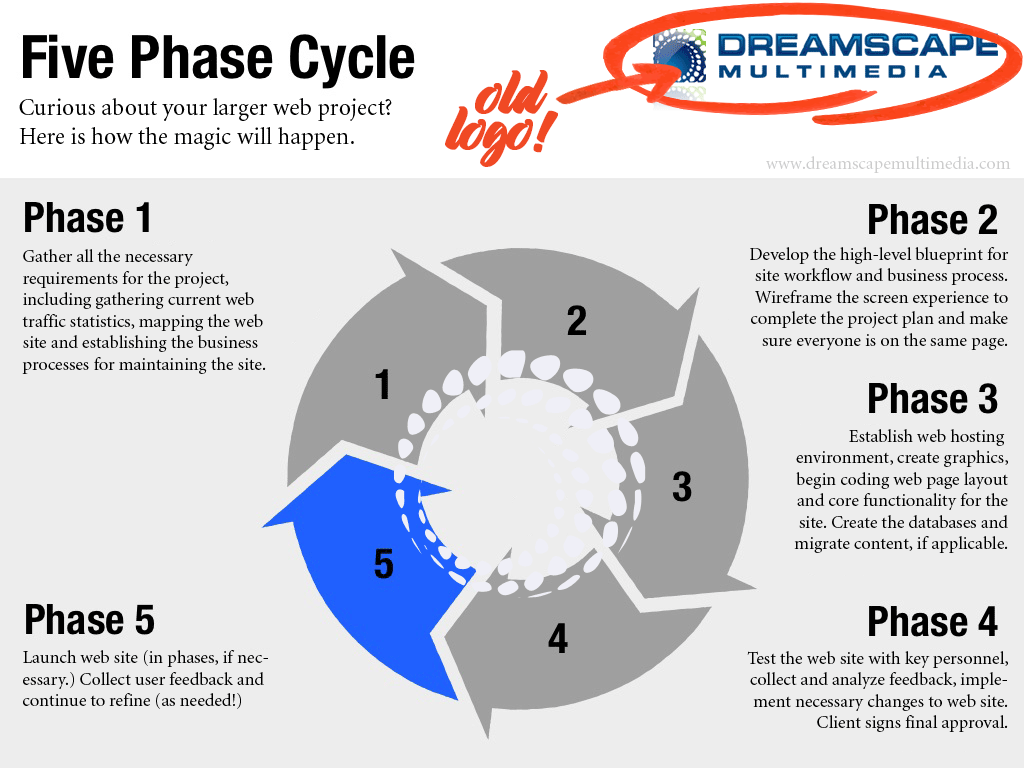
Our Old Web Design Process

0

Here is a snapshot of our web development approach to larger projects.** This usually applies to:

  • government web design
  • educational web design
  • ecommerce web design
  • municipal web design
  • and web design projects for many professionals, such as law firms, insurance agencies, real estate associations, and more.
web design process

WEB SITE REQUIREMENT PHASE

Gather all the necessary requirements for the web project, including:

  • Gathering current web traffic statistics
  • Mapping the current site layout (if a website redesign project)
  • Establishing the business processes for administering the site
  • Identifying key personnel responsible for web content provision
  • Surveying web users for greater insight

WEB SITE ANALYSIS PHASE

  • Analyze information
  • Create Project Document, containing:
    • Business Requirements (high-level blueprint for web site workflow and business process)
    • Technical Requirements (high-level blueprint for data and web technology architecture)
    • Project Scope (the project plan for implementation, detailing phases of web development and roll-out)
  • Design a graphical prototype of the web site user interface and suggested web page layout
  • Review Project Document and graphical prototype with client
  • Make necessary changes to Project Document and graphical prototype
  • Client signs off on Analysis Phase

WEB SITE IMPLEMENTATION PHASE

  • Establish web hosting environment
  • Create graphics for web design
  • Code page layout and functionality
  • Create physical databases
  • Migrate content into web site (if applicable)

WEB SITE TESTING PHASE

  • Test the web site implementation with key personnel
  • Collect and analyze feedback
  • Implement necessary changes to web site
  • Client signs off on Testing Phase

WEB SITE PRODUCTION PHASE

  • Launch web site in phases (if necessary)
  • Collect user feedback and continue to refine web site (as needed)


(**For smaller projects, we would abbreviate these phases to fit the client’s budget.)

About Bad Web Hosts

There are a lot of bad web hosts out there..
(..just ask these folks.)

One of the best things you can do for your online marketing needs is to invest in a web host that cares about their clients. If your business isn’t appreciated by any company, they don’t deserve your money. The mark of a great web hosting company is transparent service you can take for granted.

By contrast, there are a lot of bad web hosts out there. To give you an idea of what NOT to accept in a web hosting relationship, we’ve placed a few reviews below. If you find you relate to any of these stories, you need to contact us! You’ve waited too long!

These are actual reviews about real web hosts. Names have been omitted to protect the guilty.

I hate to give anyone a bad review but I’m pretty disappointed in [omitted] for the way that they let my company down with all of our websites. I tried them out because their pricing seemed great, but it just wasn’t worth it.

I can’t say that I ever got any “support” from them at all. I talked to the same young lady three times (is she the only one there?) and each time she just took my complaint in a bored fashion and never even tried to reconcile the problem or even promise to pass along my complaint to a tech department. I never even got a word back on any of those complaints. Is that called support?

When my website would actually materialize in the browser, it was excruciatingly slow and often didn’t render correctly. I can put up with bad customer service as long as I don’t need them, but to pay for shoddy hosting is just not an option for me. Perhaps if my websites were “just for fun” hobby sites, but I tend to make a living from the web. I just cannot rely on incompetent hosting if I am trying to pay the rent from sales from those websites.

The only reason that they get a [decent rating] from me is that they are cheap. But just like just about everything else in life, you get what you pay for. I will never be fooled into paying a price that is “too good to be true” again.

I had my websites set up in minutes and it was all automated so I never had a problem here. I just picked out the hosting plan I wanted, uploaded the sites, and they were online. I even set up a few cron jobs successfully with their backend with no problems. However, none of that means anything if they can’t keep the website online!

Please look elsewhere if you are looking for dependable hosting solutions. I really hate to give a bad review but I have no choice with [omitted]. They really left me no other choice. From what it looks like with other reviews that I’ve found, others seem to feel the same way.

My first thoughts of [omitted] was that they were going to be pretty good. I run a website that sells collectables to people around the world and when I first had it designed I saw [omitted] had some of the best pricing online. I wrongly figured that hosting was hosting and quickly realized that all companies are definitely NOT the same.

I can’t believe how their staff just can’t be bothered with a few questions from a customer. Perhaps if I had purchased a larger hosting package they would have been nicer to me but I was only testing the waters, so to speak before I increased my hosting needs. Every time I called to get my site set up or had a question I was put on hold for a very long time and more than once I heard someone take me off of hold just to put me back on hold and I heard laughing in the background as if they were joking around.

After I FINALLY got my website online, it would hardly ever actually come up. I thought it was my computer but I got others to test it and I eventually got one of my husband’s technically-proficient friends to have a look at it to see if I had done something wrong in setting it up. He looked at my entire website and [the hosting company’s] administrative interface and told me to call them back and ask to switch servers, which of course, they refused to do.

Their pricing was actually pretty good, which led me to pick them in the first place, but it wasn’t enough to keep me as a customer since all of their service was so bad.

This was a positively awful experience. I had never put up a website before but I did do the research before calling with my questions. I was put on hold a number of times and the representatives that I did talk to were very patronizing when they weren’t outright rude to me.

I have since switched hosting companies and the difference is night and day. [Omitted] should be ashamed of themselves for allowing their customer service representatives talk to their customers the way that they do and they should be ashamed of themselves for having such awful hosting services.

One of the worst web hosting companies on the planet is [omitted]. I’ve been in the web development game since 1994 and I’ve been with many different hosts. From the old days of getting financially slammed by companies like [omitted] to the horrible, but cheap service from [omitted].

The problems were abundant and from everything as minor as server errors that were never corrected to all the sites on my account being hacked due to their lack of control panel upgrades and security holes. Email was almost always down, people in different areas of the world couldn’t access my site and worst of all, everyday during Eastern business hours my site was completely inaccessible.

After dealing with the problems for a year I terminated my account with them. Fair warning!: If you do not officially cancel your subscription with them, they will try to charge your credit card on file, or even worse, they will bill your account and you will never get your money back for unused services.

In my experience [omitted] scores a negative -2 stars as they have lousy support, outdated operating systems, antiquated servers and negligible accounting practices. If I were you, I would avoid [omitted] like the plague.

After six years and several domains with [omitted], I’ve finally had enough and won’t be registering anymore domains with them. Furthermore, I intend to let my non essential domains expire (as I’m not going to give them the benefit of the transfer charge). I’ll simply register new domains elsewhere, and use the remaining time with [omitted] to redirect to them. I’ve already let two expire.

Hosting Plans: They offer a ‘free’ plan which is not free at all. At $25 dollars for the domain, the 100mb of hosting space, with no CGI, Perl or databases, it’s far from free.

They also offer an ‘ultra’ plan (which I don’t use) and an ‘unlimited’ plan (which I do use). Even if you opt for these more expensive plans, they still use your site to advertise themselves. The ‘free’ scripts are pretty useless, but if you do choose to use them (like a page counter or guestbook), expect to see a [omitted] link button added to your site which re-directs your visitors to the [omitted] main page.

They’ve just ‘upgraded’ their e-mail system, and in doing so have removed many of the features that the old system had. The new system is next to useless and I definitely see this as a ‘downgrade’. I see this as a platform for them to sell their expensive anti-spam software. Furthermore, you are limited to 30 e-mails per hour. If you pay for Unlimited hosting (with unlimited e-mail accounts), you don’t expect to be restricted to 30 e-mails per hour. You pay the extra for the CGI and Perl so you that you can run things like forums. However, even a small forum (where people subscribe to a thread with e-mail notifications) can eat up that ridiculous 30 per hour limit easily. My new host also has limits, but they are 500 per hour (5,000 per day).

As you might guess, I’m far from happy.

At first, I thought [omitted] were ok. Cheap price, standard setup, what’s not to like, right? I learned differently after about a week with them, though.

I can see that it probably sucks to be a customer service rep at a company that sucks so bad, but that doesn’t give these people the right to be so rude to their customers – particularly if I was being decently polite to them. And it didn’t stop at the CSR level, either. I would ask for a supervisor and they would have the same attitude. Instead of getting mad, I just cancelled my account. I figure that if enough people do that (and enough people will with their shoddy service) those people will be looking for a new job and may reconsider their snotty attitude.

[Hosting reliability was] absolutely horrific. This is what led me to call customer service in the first place. I kept getting emails and phone calls from clients and friends that were asking me what was up with my website. I had just changed over from another hosting company that I had a minor dispute with over a billing issue but I had never had problems with them keeping my website up almost all the time. As soon as I switched to [omitted], problems surfaced out of nowhere.

Who needs good pricing if you’re not getting any service? I’d rather pay four times as much as long as I knew that my website would be up when my clients visited!

Nothing to really complain about [regarding the setup process], but nothing special, either. Pretty standard setup procedure. I never had to call and ask how to do anything (thank God!!!) but I’m sure that if I did, I would have a lot more to say about them.

I encourage anyone considering using [omitted] webhosting to go elsewhere. I had nothing but problems with this host since day one. I now use [omitted] and I haven’t had a problem since. I’m not advertising for [omitted], find your own host if you don’t like them, but save yourself the heartburn and skip [omitted].

Egad. You’re right. How do I make the switch to Levaire?
You may begin your journey toward peace of mind and worry-free Christian web hosting by beginning the process of transferring your web hosting account(s) by contacting us today.

The Suicide Felt Around The World

0

On June 11, 1963, a Buddhist monk named Thích Quang Duc was among the procession of approximately 350 monks and nuns who surrounded the intersection at Phan Dinh Phung Boulevard and Le Van Duyet Street, just outside the Cambodian embassy in Saigon, South Vietnam.

“Thích Quang Duc emerged from the car along with two other monks. One placed a cushion on the road while the second opened the trunk and took out a five-gallon gasoline can. As the marchers formed a circle around him, Thích Quang Duc calmly seated himself in the traditional Buddhist meditative lotus position on the cushion. His colleague emptied the contents of the gasoline container over Thích Quang Duc’s head. Thích Quang Duc rotated a string of wooden prayer beads and recited the words Nam Mô A Di Dà Phat (“homage to Amitabha Buddha”) before striking a match and dropping it on himself. Flames consumed his robes and flesh, and black oily smoke emanated from his burning body.

“The last words of Thích Quang Duc before his self-immolation were documented in a letter he had left:

‘Before closing my eyes and moving towards the vision of the Buddha, I respectfully plead to President Ngô Dình Diem to take a mind of compassion towards the people of the nation and implement religious equality to maintain the strength of the homeland eternally. I call the venerables, reverends, members of the sangha and the lay Buddhists to organise in solidarity to make sacrifices to protect Buddhism.’

(Thich Quang Duc, http://en.wikipedia.org/wiki/Thich_Quang_Duc, retrieved November 27, 2011.)

Thích Quang Duc—and those who would later follow his example—was protesting the systemic religious persecution of Buddhism by the Roman Catholic government under President Ngô Dình Diem. It is estimated that 70-90% of the Vietnamese population was Buddhist at the time.

The photo of Duc’s death—taken by Associated Press journalist, Malcolm Browne—quickly spread around the world. It is said the image of fiery self-immolation sparked a turning point in ending the Vietnam War, in part by piercing the Western world’s sleepy awareness regarding the social evils and religious persecution occurring in Vietnam.

Self-immolation by fire had been going on for centuries prior to this. Often, the suicide was seen as a show of great respect, in honor of Gautama Buddha. In the case of Duc, self-sacrifice was used as a public outcry against religious persecution. It is doubtful Thích Quang Duc could have fully foreseen the worldwide impact of his death, though the presence of the media had indeed been encouraged. The day prior to Thích Quang Duc’s death, a spokesperson for the Buddhists had informed U.S. correspondents that “something important” would be happening at the intersection the next day.

These suicide protests helped bring awareness to the languishing Vietnam War, making suicide a tool of shock, used to break through human apathy. On its own, Thích Quang Duc’s self-immolation—without a worldwide audience—would not have had the same impact. The press was a necessary partner, rendering the act considerably more effective as a result.

In Regard to the Concept of Respect

An environment of religious inequality and disrespect had already been fostered by the Diem regime. Signs of unrest included:

  • The Buddhist flag had been banned
  • Aid was being directed toward Roman Catholic villages, neglecting Buddhist villages whom refused to convert
  • Weapons had been taken from Buddhist soldiers and given to their Roman Catholic counterparts
  • Military officers converted to Roman Catholicism in order to gain access to promotions
  • Forced conversions under the threat of violence were becoming more prevalent
  • Buddhist protests were growing in frequency and size
  • Government intervention, intended to quell the protests, had already lead to numerous deaths

Vietnam was deep in the throes of conflict and the Buddhist majority railed against the growing atmosphere of intolerance.

In circumstances where respect for a population is extremely low, dissent will spring up, giving rise to civil unrest. The effect of the widespread disrespect by the Diem regime is obvious in this case, but where does the self-immolation of Thích Quang Duc and others fit into the concept of respect?

If suicide is an ultimate sign of self-disrespect (I think it is safe to state setting oneself on fire would not be a sign of physical respect,) what happens if it is used as a tool for ending disrespect against a people? In Thích Quang Duc’s own words, his death was a plea for “religious equality.”

Regardless of which religious belief systems were involved, I believe what matters is the idea that one group was ostracized by the other. In order to bring greater awareness to the issue of religious disrespect, Thích Quang Duc made his last act a symbol to be captured and promoted to the world.

Could Thích Quang Duc’s statement have been made as powerfully any other way?

Why the Pro-Life Movement is Quiet on Capital Punishment

0
  • If someone you loved was assaulted and murdered, wouldn’t you demand justice?
  • Wouldn’t you want to protect your family, friends and others from such a brutal event ever happening again?
  • Wouldn’t you want the murderer permanently removed from society?
  • To ensure a murderer never kills again, wouldn’t the surest and quickest way be to end the murderer’s life?

Throughout history, many cultures have supported the “eye for an eye” justice system, whereby an offender is granted an equal punishment to match their wrong-doing. In the case of killing another person, this often meant death.

When I first became involved with the pro-life movement (shortly after having a dream about the end of days), I was surprised to find most pro-life organizations do not take a position on the death penalty. While sanctity of life is often discussed in those circles, the tendency is to focus on right to life for unborn babies, the elderly or the infirmed. This may be for several reasons.

  1. The notion that life is sacred and worth protecting is an easier pitch when showing pictures of cooing babies or regal elderly than it is to argue a convicted serial murderer’s life has intrinsic value and should be spared.
  2. To be most effective, many organizations targeting cultural change opt to pick a single goal and focus on achieving it with laser-fine intensity. The idea is to achieve more with focused effort on a single cause than to thin your efforts over the herculean task of social change using a scattershot approach. In furthering the sanctity of human life movement, pro-life organizations predominately target protecting unborn babies. They do this through a number of activities, including lobbying, traditional marketing, educating and assisting community groups such as churches, pregnancy service centers and student organizations.
  3. Still, why not simply state a position on capital punishment and then let it rest at the sidelines? Why maintain a stance of “no stance” on the death penalty at all? There may be a feeling that addressing capital punishment—even at a surface level—gives the pro-choice opposition more ammunition. Think about it. If you are a pro-abortion leader who is trying to do your part to undermine the pro-life argument, which would you rather bring to your audience’s attention?
    1. The pro-life movement supports the right of the unborn to continue living; a right they say supersedes any desire the mother has to be free of the pregnancy. ~or~
    2. The pro-life movement wants to protect the murderer who slaughtered someone’s son or daughter, husband or wife, mother or father.

Right. Option B would be much harder to defend.

In the United States, up until the late 1960’s, people were still being mob-lynched for race, religious beliefs and criminal activity. Other places across the globe are still seeing terminal mob-justice today. For example, following the earthquake that rocked Haiti in 2010, suspected looters were lynched by angry mobs. In South Africa, drug dealers and gang members have recently been hanged by vigilante groups.

“An eye for an eye makes the whole world blind.” ~ Mahatma Gandhi

(Originally posted at prosanctityoflife.com on October 28, 2011.)

Pro-Choice Mom Believes Any Reason Will Do

Recently, I stumbled across a blog that stated the following:

“As you all know, I am pro-choice. I don’t believe in parental notification laws. I believe you can have an abortion for whatever reason you want. And yes I am a mother. And yes I was upset when I miscarried cuz that was a baby to me. However, IT IS MY CHOICE!!! And that’s what the abortion debate is about. […] Fine, if you are prolife. I don’t push my opinions on you and I expect you to do the same.”

A few things struck me here:

  1. This person is a mother and still believes—even after having gone through the whole pregnancy and childbirth experience—that abortion (the right to kill her baby in utero) is still something she thinks she wants to defend.
  2. She admits she is aware there is a baby within. (Pro-abortionists usually favor referring to an unborn baby as a zygote or fetus—anything to avoid calling it a baby, because really—who wants to kill an innocent, defenseless baby? Killing babies is just bad mojo.)
  3. She illustrates defensiveness over anyone telling her what she can and cannot do with her body. This appears to be the main foundation upon which she rests her entire pro-choice position. One can only wonder if she takes other physical mandates as personally. After all, it’s against the law to physically assault others with your body. It’s against the law to neglect buckling your body into your car. It’s against the law to walk in public while nude. We have all these laws that tell us what we can and cannot do, where we can and cannot go and even what we can and cannot say.
  4. She says it’s not her place to tell others what to do. Isn’t this what laws are? Rules, created by people, set to define appropriate behavior? We live in a world of laws; otherwise we live in a world of chaos. Daily, we choose to either work within those laws (citizen), without those laws (criminal), or on the laws (lawmaker.) Throughout our lives, most of us have donned two or three of these roles at one time or another, to varying degrees.

I think the most troubling idea here is the notion this mother knows there is a baby in the womb but thinks her “right” is more important than her baby’s life. Some questions I’m struggling with:

  • Does this rigidity offer her a much needed sense of control or certainty in her life?
  • Does she feel her life is so restricted by laws that tell her what she can and cannot do with her body that she simply cannot bear one more law?
  • Is it that she was influenced by someone close to her in her past and now subconsciously clings to the pro-abortion paradigm that was originally given to her?

And the biggest question of all:

  • What pushes this young mother to defend this pro-abortion mindset even after seeing her baby for the first time? Can a new mother truly look at her newborn baby after enduring 10 months of pregnancy’s highs and lows and think, “Yes, I should definitely have had the right to kill this child while she was inside my body?”

Really?

(Originally posted at prosanctityoflife.com on October 23, 2011.)