Home Blog Page 44

What Does the Book of Job Teach Us About the Sovereignty of God?

4

Our holy Father calls us back from the Fall into deeper relationship with Him. As in our natural relationships, part of growing in relationship with someone is gaining clear understanding into who they are; their character.

There are favorite tactics the Enemy employs to lead us astray. In the garden, He attacked God’s Word (Genesis 3:4, “You will surely not die..”) In Job 1:11, the Accuser admonishes God and accuses Job of fair-weather faith (“But put forth thine hand now, and touch all that he hath, and he will curse thee to thy face.”) Here, Satan attacks the character of both God and mankind.

Enemy rule

Framework for understanding God’s sovereignty in our earthly lives comes in the next lines. “Behold, all that he hath is in your power; only upon himself put not forth your hand.” In God’s sovereign position, He states the limitations to Satan; in this moment, Job is not to be touched. We also recognize Satan is the ruler of this world; allowed at the fall of Adam and Eve when sin entered creation. This is reinforced in the following scriptures:

  • 2 Corinthians 4:4 (ESV) “In their case the god of this world has blinded the minds of the unbelievers, to keep them from seeing the light of the gospel of the glory of Christ, who is the image of God.”
  • Matthew 4:9 (KJV) “And saith unto him, All these things will I give thee, if thou wilt fall down and worship me.” (How could Satan offer Jesus the kingdoms of the world if he did not control them? He couldn’t.)
  • John 12:31 (KJV) “Now is the judgment of this world: now shall the prince of this world be cast out.”
  • Ephesians 2:2 (KJV) “Wherein in time past ye walked according to the course of this world, according to the prince of the power of the air, the spirit that now worketh in the children of disobedience:”
  • 1 John 5:19 (ESV) “We know that we are from God, and the whole world lies in the power of the evil one.”
  • Revelation 12:9 (KJV) “And the great dragon was cast out, that old serpent, called the Devil, and Satan, which deceiveth the whole world: he was cast out into the earth, and his angels were cast out with him.”

This completely refutes the common, errant belief that God is in control of everything. Indeed, the powers of darkness were given jurisdiction over this world through the lie of Satan and the selfishness of Adam and Eve when they took their eyes off God and placed them upon the fruit of this world (Genesis 3:16-19).

God is sovereign, yes, but He is not controlling every aspect of our lives. If God was in control of our lives, there would be

  • no reaping or sowing (Galatians 6:7-8),
  • no need for prayer (Matthew 6:6),
  • no one would be destroyed for lack of knowledge (Hosea 4:6),
  • the power of life and death would not be in the tongue (Proverbs 18:21), and
  • there would be no reason for you to be given authority (Matthew 28:18), a sword or the armor of God (Ephesians 6:13).

The belief that God is ordaining every attack in your life is false! Reaping and sowing in ignorance equates to people being “destroyed for lack of knowledge.” (Hosea 5:6, Isaiah 5:13)

Did God give Satan permission to attack Job?

Some pastors preach if you believe God gave Satan permission to attack Job, you will believe God ordains all sickness, death and loss. Jesus clearly stated the thief comes to steal, kill and destroy and that He came to give life and life abundant (John 10:10). Believing God ordained all your sickness, the untimely death of a loved one, or other loss is certainly error. It sets you up for an estranged relationship with your Heavenly Father and a walk with no authority; just what the Enemy wants. However, the Bible teaches us the storms come to the wise and the foolish alike (Matthew 7:24-27). Your walk as a believer will not be trouble-free. Christ’s promise to us is for a peace that transcends all understanding if we keep our minds and hearts on Him (Philippians 4:7).

Yes, God lifted the hedge of protection around Job after drawing Satan’s attention to Job in the first place.

Does God test us?

If Satan rules this world and God is not to blame for our disease, losses and calamity, how do we reconcile the following verses?

  • Psalm 11:5 “The Lord tests the righteous,”
  • Proverbs 17:3 “The crucible is for silver, the furnace for gold and the Lord test hearts,”
  • Jeremiah 11:20, 20:12 “O Lord of hosts, who judges righteously, who tests the hearts and minds,” and
  • 1 Thessalonians 2:4 “So we speak, not to please man, but to please God who tests our hearts.”

In both examples where Satan petitions to attack Job, God not only pointed Job out in the first place but also set the guidelines for the trials. This is likely for a number of reasons, which may include:

  • God had faith in His servant,
  • God desired to see Job grow in his understanding and relationship with Him, and
  • God held divine intention for Job’s example to be immortalized in Scripture for the development of future believers.

The Father, in His sovereignty, places the limitations upon the attack. 1 Corinthians 10:13 states,

“There hath no temptation taken you but such as is common to man: but God is faithful, who will not suffer you to be tempted above that ye are able; but will with the temptation also make a way to escape, that ye may be able to bear it.”

Here, “temptation” is the same word as “test” in the Greek. If read with this understanding, it is not simply the test of temptation to our fleshly desires, but also the tests of a distracting and corrupting natural world, false understanding and tests through physical adversity and loss.

Are all tests and trials from Satan? No. This brings us back to reaping and sowing and false thinking. So not all tribulation is from the devil, but still, what about protection and Satan’s agency? Does God lower the hedge to test our hearts?

Doesn’t God promise to protect us?

So, how does this work? Does God actually employ or allow Satan to test us through trials? Does He remove protection around us to allow in these attacks? Yes, God even has made a covenant of protection with those who walk with him in Psalm 91. Surely this protection is not completely removed all at once, just as Job’s account illustrates (Job 1:10). Otherwise, Satan would sweep us all to the grave before we could grow one more moment in the Lord!

From betrayal by his brothers, false accusations and imprisonment, Joseph faced many attacks, but in each instance, he kept his eyes on the Lord. As he told his brothers, “But as for you, ye thought evil against me; but God meant it unto good, to bring to pass, as it is this day, to save much people alive.” (Genesis 50:20)

Do our chances for testing rise and fall with the righteousness of our walk? Adam and Eve were seduced in the garden. They possibly walked in the closest proximity with God of anyone until Christ and still fell to their own desires through a simple lie. If you live for the flesh, you will set your heart upon the flesh (Romans 8:5-17).

Even Christ suffered. He was tempted, accused, betrayed, beaten and crucified. He suffered hunger and weariness and grief. As Romans 8:17 states, “We suffer with Him in order that we may be glorified with Him.”

During his ordeal, Job did not see why God allowed his misfortune, however if we look at the result, he and his friends grew in their knowledge of God’s character as a result of Job’s trials. God is much more interested in your spiritual development than He is your material well-being.

Wasn’t it God that struck Job?

Was it “the fire of God” (Job 1:16) that burned up Job’s flocks and servants? No, God did not stretch forth His hand and burn up Job’s flocks in a lightning storm; Satan did. Well then, what about in Job 2:3 where God says Satan moved God against Job to “destroy him without cause.” Does Satan have influence over our Father? No. Just as with the crucifixion of our Lord, Satan blindly plays right into God’s plan here in Job. As God says, “Have you considered my servant, Job?” God draws Satan’s attention onto the subject of the next test. In Satan’s rabid distaste for humanity, he charges headlong after the bait and by the end of the story, Job has been magnified.

Is Satan a fool to participate in our downfall then?

Unfortunately not. If his fiery darts often derail and distract the most dedicated Christians, imagine his success with those who are in the world and have not sought to be set apart from it. As illustrated in 1 Peter 5:8, Satan prowls around like a roaring lion looking for someone to devour. Every now and again, a Christian may resist the Enemy and win a victory, but as the Accuser, suffice it to say Satan already has a low opinion of our character. This is why it is so important for us to grow in our identity as sons and daughters, made in His image!

The Butterfly: A Map of Testing, Death and Rebirth

“But ask now the beasts, and they shall teach thee; and the fowls of the air, and they shall tell thee:” (Job 12:7 KJV)

Consider the butterfly for a moment. In the cocoon, the caterpillar dies, its insides literally turning to soup. Over the next few weeks, a new creature is established. This new life is a completely different design, even down to what it will consume for fuel. During the butterfly’s birth, the cocoon itself serves a final purpose. If a butterfly is freed from its cocoon thereby avoiding the struggle to emerge, the fluid in its body will never be pushed into its wings to straighten them. Without the use of its wings, the butterfly cannot take flight and will die.

“For the invisible things of him from the creation of the world are clearly seen, being understood by the things that are made, even his eternal power and Godhead; so that they are without excuse:” (Romans 1:20 KJV)

Could this not be an eye-catching clue from the Divine Artist who spoke the cosmos into existence and who paints in light and sound and consciousness? How are we to learn to live in faith if we never have our faith tested? If Jesus is the Way, the Truth and the Life and He met with adversity (from Satan, nature and mankind,) can’t we expect to as well? Does not a seed have to die in order for a great tree to be born? Are we not called to die to self daily, in order to be grown up in Him?

Summary

Often we are guilty of thinking of ourselves and others as the bodies we wear, but Genesis is very clear: we were created in His image. We know from John 4:24, God is spirit. Then so we are too. The Father restores us to the full realization of our true, pre-Fallen identity through the Gospel of Jesus Christ. Without tests and adversity in our lives, what reason would we have to grow? With trial, we have the chance to press into Him and His Word (which He honors above all, Psalm 138:2,) through faith and belief in love. When faced with trial then, we keep our eyes on Him and His promises. Our natural minds will want to argue as we bump our heads on the ceiling of our faith but we are called to a higher faith. That faith works miracles, heals all sickness and overcomes death itself. As the last Adam (1 Corinthians 15:45,) Jesus has come to show us our true identity in the Father. He calls us away from the lies and distraction of the natural world and into life through union with the Holy Spirit.

In all things, we must remember the following truth from 55:9:

“For as the heavens are higher than the earth, so are my ways higher than your ways, and my thoughts than your thoughts.”

This is about where I’m landing for now on the sovereignty of God. I think there are still some holes in my understanding on this topic, so if you can help fill them in, I encourage you to comment below.

matt signature


References

Got Questions. Retrieved from http://www.gotquestions.org/amp/Satan-god-world.html

Got Questions. Retrieved from http://www.gotquestions.org/amp/God-allow-Satan-attack.html

Answers in Genesis. Retrieved from http://answersingenesis.org/is-god-real/the-creator-clearly-seen/

Ye are gods, He said

0

As I lifted my Bible this morning, I began reading in the middle of John 10. Funny, I didn’t see this yesterday when I read the same passage, but today it seems a deeper meaning is clear. Buckle up. Some may cry ‘heresy’ by the time I’m through.

Here, I’m highlighting John 10:33-38. Verses 22-32 have been included to help with context.

John 10:22-38

22 And it was at Jerusalem the feast of the dedication, and it was winter.

23 And Jesus walked in the temple in Solomon’s porch.

24 Then came the Jews round about him, and said unto him, How long dost thou make us to doubt? If thou be the Christ, tell us plainly.

25 Jesus answered them, I told you, and ye believed not: the works that I do in my Father’s name, they bear witness of me.

26 But ye believe not, because ye are not of my sheep, as I said unto you.

27 My sheep hear my voice, and I know them, and they follow me:

28 And I give unto them eternal life; and they shall never perish, neither shall any man pluck them out of my hand.

29 My Father, which gave them me, is greater than all; and no man is able to pluck them out of my Father’s hand.

30 I and my Father are one.

31 Then the Jews took up stones again to stone him.

32 Jesus answered them, Many good works have I shewed you from my Father; for which of those works do ye stone me?

33 The Jews answered him, saying, For a good work we stone thee not; but for blasphemy; and because that thou, being a man, makest thyself God.

34 Jesus answered them, Is it not written in your law, I said, Ye are gods?

35 If he called them gods, unto whom the word of God came, and the scripture cannot be broken;

36 Say ye of him, whom the Father hath sanctified, and sent into the world, Thou blasphemest; because I said, I am the Son of God?

37 If I do not the works of my Father, believe me not.

38 But if I do, though ye believe not me, believe the works: that ye may know, and believe, that the Father is in me, and I in him.

Today, verse 34 particularly jumped out at me. “Written in your law,” “I said” and “Ye are gods”. My KJV tells me the Master is referencing Psalm 82, a psalm of Asaph. Here it is in its entirety, my emphasis on verses 5-7:

82 God standeth in the congregation of the mighty; he judgeth among the gods.

2 How long will ye judge unjustly, and accept the persons of the wicked? Selah.

3 Defend the poor and fatherless: do justice to the afflicted and needy.

4 Deliver the poor and needy: rid them out of the hand of the wicked.

5 They know not, neither will they understand; they walk on in darkness: all the foundations of the earth are out of course.

6 I have said, Ye are gods; and all of you are children of the most High.

7 But ye shall die like men, and fall like one of the princes.

8 Arise, O God, judge the earth: for thou shalt inherit all nations.

The authors of this KLV study Bible (Reformation Heritage) note “’like men’, literally, ‘As Adam’ (Job 31:33, Hosea 6:7), perhaps an allusion to the fall of the first man, appointed to rule the earth (Genesis 1-3).”

I believe the word “perhaps” here is a gross understatement. I firmly believe Psalm 82:6 is a reference to our state prior to the Fall. This is not to say I think we are gods in the ancient pagan or Mormon sense of the word, but that we—crafted in His likeness and sanctified through faith—grow more God-like the closer our walk with the Father through the radiant indwelling of the Holy Spirit.

Genesis 1:26 confirms our original divine nature when it says “And God said, Let us make man in our image, after our likeness: and let them have dominion over the fish of the sea, and over the fowl of the air, and over the cattle, and over all the earth, and over every creeping thing that creepeth upon the earth.” The escape from the fiery furnace in Daniel 3 and the closing of the mouths of the lions in Daniel 6 backed by Psalm 91’s covenant of protection are only a few examples that further echo this elevated supernatural state awaiting the one who believes the Word of God over their perceived ‘reality’. Christ’s example to us was certainly one of dominion over all nature; even death. He is our example of what it looks like to “subdue the earth” (Genesis 1:28).

In Mark 9:23, Jesus was clear when He said, “If thou canst believe, all things are possible to him that believeth.” So what do the conservative “believers” do with this claim when it come crashing into their tradition and their powerless walk? “Oh, but that was Jesus,” they say. “He didn’t really mean ALL things are possible.”

No, I think this applies to us. I think Jesus meant what He said.

I think the “all” in “all things are possible” means “all.”

What do you think?

Restless Water

0

Fable of the Restless Water
You are you, no matter when or who.

One day, a little water droplet awoke to find herself surrounded by the great blue Ocean, reaching out from her as far as her eyes could see. At first, she delighted in exploring all the sights, sounds and sensations the Ocean had to offer, but after a time she became restless.

The droplet went to the Sun and said, “Sun, I would like to become a Cloud. I wish to soar the sky and be adored by all the World.”

The Sun said, “Imagine soaring the sky and you will be.”

So the droplet climbed to the top of her Ocean, closed her eyes and thought soaring thoughts. When she looked again, she was flying high in the sky. She looked down at the great blue Ocean and asked, “Sun, what is the Ocean made of?”

“Water,” Sun replied.

The droplet seemed satisfied with this and enjoyed soaring the sky and being adored by all the World. After a time, however, she became restless.

She went to the North Wind and said, “North Wind, I would like to become Rain. I wish to fall to the Earth and bring life to all the World.”

North Wind said, “Imagine falling to the Earth and you will be.”

So the droplet climbed to the bottom of her Cloud, closed her eyes and thought falling thoughts. When she looked again, she was falling to the Earth. As she fell, the droplet looked up at her Cloud and asked, “North Wind, what are Clouds made of?”

“Water,” said North Wind.

“Oh,” said the droplet, a little confused now.

Once she landed upon the Earth, however, she busied herself with bringing life to all the World. She was quite happy for a time, but—after a while—the droplet became restless.

She went to the River and said, “River, I would like to know who I am. I have been the Ocean, and the Clouds, and the Rain and now I even bring life to all the World, but I still don’t know what I am supposed to be.”

River said “Follow me.”

The droplet joined River and soon found herself returned to the Ocean. The droplet was dismayed by this and cried, “River! I don’t understand! I have already been the Ocean!”

River said, “When you were Ocean, you wanted to be Cloud.
When you were Cloud, you wanted to be Rain.
When you were Rain, you brought life to all the World and yet,
you still became restless and wondered what you were to do.
Know you are Water and—in being Water—you are the Ocean, the Cloud, the River and the Rain.”

And, from that moment forward, the little droplet knew she was Water and felt peace, no matter what she decided to be.

Jewish Rabbi Claims Life Beginning at Conception is Religion; Not Science

Tonight, I heard a Jewish rabbi make the argument for a pro-choice stance in Reform Judaism. When I asked how they balance a pro-choice position against “Thou shalt not kill” she pointed to a semantic difference between murder and killing (according to the original Hebrew, she said.) She then alluded to a passage in the Torah regarding two men fighting and a pregnant bystander being hurt in the process. She said this story was proof that the unborn child was considered part of the mother—not an individual apart from the mother—because the value given in retribution was more akin to losing and arm or a leg; not capital punishment.

I looked this up when I returned home. Seems she was referring to Exodus 21:22-25 which pertains to Mosaic personal injury law. Here is the passage, from both the KJV and ESV and then finally from the Jewish Tanakh:

King James Version

“If men strive, and hurt a woman with child, so that her fruit depart from her, and yet no mischief follow: he shall be surely punished, according as the woman’s husband will lay upon him; and he shall pay as the judges determine. And if any mischief follow, then thou shalt give life for life, Eye for eye, tooth for tooth, hand for hand, foot for foot, Burning for burning, wound for wound, stripe for stripe.”

English Standard Version

“When men strive together and hit a pregnant woman, so that her children come out, but there is no harm, the one who hit her shall surely be fined, as the woman’s husband shall impose on him, and he shall pay as the judges determine. But if there is harm, then you shall pay life for life, eye for eye, tooth for tooth, hand for hand, foot for foot, burn for burn, wound for wound, stripe for stripe.”

As you can see, these two translations leave some question as to whether the child is included in the “life for life” retribution. The Jewish bible, however, seems to take things a bit further:

Jewish Tanakh (English)

“When men fight, and one of them pushes a pregnant woman and a miscarriage results, but no other damage ensues, the one responsible shall be fined according as the woman’s husband may exact from him, the payment to be based on reckoning. But if other damage ensues, the penalty shall be life for life, eye for eye, tooth for tooth, hand for hand, foot for foot, burn for burn, wound for wound, bruise for bruise.”

So I can understand why someone reading this latter translation would think this was a clear statement from God that the life of the unborn child didn’t matter as much as the adult’s. The rabbi likened the unborn child to an appendage and even said the child wasn’t considered a person until it was at least half-born (e.g. the child’s head and shoulders had emerged from the vaginal canal.) This is absolutely stunning to me. I marvel at the disconnected thinking it takes to arrive at the conclusion that a few inches and being on the wrong side of the mother’s womb should mean it’s okay to destroy what God has created.

I asked how she rectifies science having proven life begins at conception and she defensively claimed, “Science doesn’t claim that; religion does.”

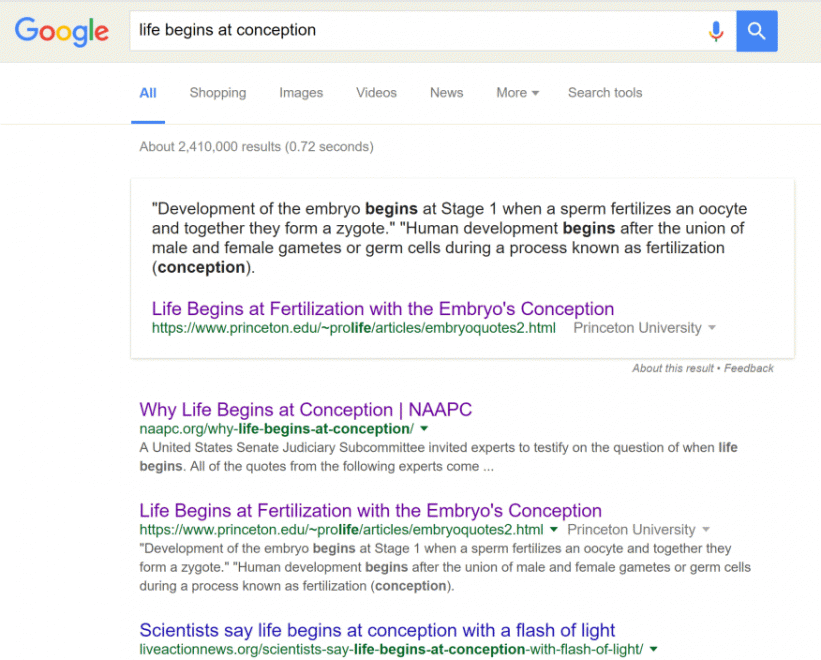
I’ll admit, this was the first time I had ever heard this rebuttal. I had to do a little research to determine if this was the case. Turns out I didn’t have to look far. Her comment is utterly false. The first thing I found upon doing a search for “life begins at conception” (without quotes) looked like this:

life begins at conception


From here I found two pages dedicated to examples whereby secular university textbooks seem to clearly state genetic uniqueness and specifically, that the resulting cell from the egg and sperm marks the “beginning of a new human being.” (Moore, 2003.) I’ve reproduced the contents of those pages below.

I’ll leave you to come to your own conclusions on this material. Personally, I believe God values us so much He sent His only Son to die for us (which I can’t even begin to wrap my head around.) I believe every life is of massive value to our heavenly Father. We are His work, after all.

For You formed my inward parts;
You covered me in my mother’s womb.
I will praise You, for I am fearfully and wonderfully made;
Marvelous are Your works,
And that my soul knows very well.
My frame was not hidden from You,
When I was made in secret,
And skillfully wrought in the lowest parts of the earth.
Your eyes saw my substance, being yet unformed.
And in Your book they all were written,
The days fashioned for me,
When as yet there were none of them.

Psalm 139:13-16 NKJV

matt signature


Human Development

Assorted Quotes from Textbooks

The Developing Human Being
By Keith Moore, and T.V.N. Persaud
7th edition, 2003

From an introductory definition section:

“Human development is a continuous process that begins when an oocyte (ovum) from a female is fertilized by a sperm (spermatozoon) from a male. Cell division, cell migration, programmed cell death, differentiation, growth, and cell rearrangement transform the fertilized oocyte, a highly specialized, totipotent cell–a zygote–into a multicellular human being. Although most developmental changes occur during the embryonic and fetal periods, important changes occur during later periods of development: infancy, childhood, adolescence, and early adulthood. Development does not stop at birth. Important changes, in addition to growth, occur after birth (e.g., development of teeth and female breasts). The brain triples in weight between birth and 16 years; most developmental changes are completed by the age of 25. Although it is customary to divide human development into prenatal (before birth) and postnatal (after birth) periods, birth is merely a dramatic event during development resulting in a change in environment.” (p. 2)

“Zygote. This cell results from the union of an oocyte and a sperm during fertilization. A zygote is the beginning of a new human being (i.e., an embryo).” (p. 2)

“Embryo. The developing human during its early stages of development. The embryonic period extends to the end of the eighth week (56 days), by which time the beginnings of all major structures are present.” (p. 3)

From chapter 2: “The Beginning of Human Development: First Week”

First sentence of the chapter: “Human development begins at fertilization when a male gamete or sperm (spermatozoon) unites with a female gamete or oocyte (ovum) to form a single cell–a zygote. This highly specialized, totipotent cell marked the beginning of each of us as a unique individual.” (p. 16)

“Studies on early stages of development indicate that human oocytes are usually fertilized with 12 hours after ovulation. In vitro observations have shown that the oocyte cannot be fertilized after 24 hours and this it degenerates shortly thereafter.” [This would buttress our argument that sperm and ovum by themselves are parts of the parents and not entire beings. That there is a substantial change between gametes and zygotes.] (p. 31)

“The zygote is genetically unique because half of its chromosomes come from the mother and half from the father. The zygote contains a new combination of chromosomes that is different from that in the cells of either of the parents.” (p. 33)

“Cleavage consists of repeated mitotic divisions of the zygote, resulting in a rapid increase in the number of cells. The embryonic cells–blastomeres–become smaller with each cleavage division. First the zygote divides into two blastomores, which then divide into four blastomores, either blastomeres, and so on.” (p. 36-37) [We can use the cleavage discussion to show that now the embryo is operating on its own and developing.]


Human Embryology
William J. Larsen
3rd edition, 2001

“In this text, we begin our description of the developing human with the formation and differentiation of the male and female sex cells or gametes, which will unite at fertilization to initiate the embryonic development of a new individual” (p. 1)

“After the oocyte finishes meiosis, the paternal and maternal chromosomes come together, resulting in the formation of a zygote containing a single diploid nucleus. Embryonic development is considered to begin at this point. The newly formed embryo undergoes a series of cells divisions called cleavage as it travels down the oviduct toward the uterus. The cleavage divisions subdivide the zygote first into two cells, then into four, then into eight, and so on.” (p. 1-3)


Life Begins at Fertilization

The following references illustrate the fact that a new human embryo, the starting point for a human life, comes into existence with the formation of the one-celled zygote:


“Development of the embryo begins at Stage 1 when a sperm fertilizes an oocyte and together they form a zygote.”

[England, Marjorie A. Life Before Birth. 2nd ed. England: Mosby-Wolfe, 1996, p.31]


“Human development begins after the union of male and female gametes or germ cells during a process known as fertilization (conception).

“Fertilization is a sequence of events that begins with the contact of a sperm (spermatozoon) with a secondary oocyte (ovum) and ends with the fusion of their pronuclei (the haploid nuclei of the sperm and ovum) and the mingling of their chromosomes to form a new cell. This fertilized ovum, known as a zygote, is a large diploid cell that is the beginning, or primordium, of a human being.”

[Moore, Keith L. Essentials of Human Embryology. Toronto: B.C. Decker Inc, 1988, p.2]


“Embryo: the developing organism from the time of fertilization until significant differentiation has occurred, when the organism becomes known as a fetus.”

[Cloning Human Beings. Report and Recommendations of the National Bioethics Advisory Commission. Rockville, MD: GPO, 1997, Appendix-2.]


“Embryo: An organism in the earliest stage of development; in a man, from the time of conception to the end of the second month in the uterus.”

[Dox, Ida G. et al. The Harper Collins Illustrated Medical Dictionary. New York: Harper Perennial, 1993, p. 146]


“Embryo: The early developing fertilized egg that is growing into another individual of the species. In man the term ’embryo’ is usually restricted to the period of development from fertilization until the end of the eighth week of pregnancy.”

[Walters, William and Singer, Peter (eds.). Test-Tube Babies. Melbourne: Oxford University Press, 1982, p. 160]


“Embryo: The developing individual between the union of the germ cells and the completion of the organs which characterize its body when it becomes a separate organism…. At the moment the sperm cell of the human male meets the ovum of the female and the union results in a fertilized ovum (zygote), a new life has begun…. The term embryo covers the several stages of early development from conception to the ninth or tenth week of life.”

[Considine, Douglas (ed.). Van Nostrand’s Scientific Encyclopedia. 5th edition. New York: Van Nostrand Reinhold Company, 1976, p. 943]


“I would say that among most scientists, the word ’embryo’ includes the time from after fertilization…”

[Dr. John Eppig, Senior Staff Scientist, Jackson Laboratory (Bar Harbor, Maine) and Member of the NIH Human Embryo Research Panel — Panel Transcript, February 2, 1994, p. 31]


“The development of a human being begins with fertilization, a process by which two highly specialized cells, the spermatozoon from the male and the oocyte from the female, unite to give rise to a new organism, the zygote.”

[Langman, Jan. Medical Embryology. 3rd edition. Baltimore: Williams and Wilkins, 1975, p. 3]

“The development of a human begins with fertilization, a process by which the spermatozoon from the male and the oocyte from the female unite to give rise to a new organism, the zygote.”

[Sadler, T.W. Langman’s Medical Embryology. 7th edition. Baltimore: Williams & Wilkins 1995, p. 3]

“Development begins with fertilization, the process by which the male gamete, the sperm, and the female gamete, the oocyte, unite to give rise to a zygote.”

[Sadler, T.W. Langman’s Medical Embryology. 9th edition. Baltimore: Williams & Wilkins 2004, p. 3]

“The results of fertilization are (a) restoration of the diploid number of chromosomes, (b) determination of chromosomal sex, and (c) initiation of cleavage.”

[Sadler, T.W. Langman’s Medical Embryology. 9th edition. Baltimore: Williams & Wilkins 2004, p. 48]


“The question came up of what is an embryo, when does an embryo exist, when does it occur. I think, as you know, that in development, life is a continuum…. But I think one of the useful definitions that has come out, especially from Germany, has been the stage at which these two nuclei [from sperm and egg] come together and the membranes between the two break down.”

[Jonathan Van Blerkom of University of Colorado, expert witness on human embryology before the NIH Human Embryo Research Panel — Panel Transcript, February 2, 1994, p. 63]


“Zygote. This cell, formed by the union of an ovum and a sperm (Gr. zyg tos, yoked together), represents the beginning of a human being. The common expression ‘fertilized ovum’ refers to the zygote.”

[Moore, Keith L. and Persaud, T.V.N. Before We Are Born: Essentials of Embryology and Birth Defects. 4th edition. Philadelphia: W.B. Saunders Company, 1993, p. 1]


“The chromosomes of the oocyte and sperm are…respectively enclosed within female and male pronuclei. These pronuclei fuse with each other to produce the single, diploid, 2N nucleus of the fertilized zygote. This moment of zygote formation may be taken as the beginning or zero time point of embryonic development.”

[Larsen, William J. Human Embryology. 2nd edition. New York: Churchill Livingstone, 1997, p. 17]


“Although life is a continuous process, fertilization is a critical landmark because, under ordinary circumstances, a new, genetically distinct human organism is thereby formed…. The combination of 23 chromosomes present in each pronucleus results in 46 chromosomes in the zygote. Thus the diploid number is restored and the embryonic genome is formed. The embryo now exists as a genetic unity.”

[O’Rahilly, Ronan and Müller, Fabiola. Human Embryology & Teratology. 2nd edition. New York: Wiley-Liss, 1996, pp. 8, 29. This textbook lists “pre-embryo” among “discarded and replaced terms” in modern embryology, describing it as “ill-defined and inaccurate” (p. 12}]


“Almost all higher animals start their lives from a single cell, the fertilized ovum (zygote)… The time of fertilization represents the starting point in the life history, or ontogeny, of the individual.”

[Carlson, Bruce M. Patten’s Foundations of Embryology. 6th edition. New York: McGraw-Hill, 1996, p. 3]


“[A]nimal biologists use the term embryo to describe the single cell stage, the two-cell stage, and all subsequent stages up until a time when recognizable humanlike limbs and facial features begin to appear between six to eight weeks after fertilization….

“[A] number of specialists working in the field of human reproduction have suggested that we stop using the word embryo to describe the developing entity that exists for the first two weeks after fertilization. In its place, they proposed the term pre-embryo….

“I’ll let you in on a secret. The term pre-embryo has been embraced wholeheartedly by IVF practitioners for reasons that are political, not scientific. The new term is used to provide the illusion that there is something profoundly different between what we nonmedical biologists still call a six-day-old embryo and what we and everyone else call a sixteen-day-old embryo.

“The term pre-embryo is useful in the political arena–where decisions are made about whether to allow early embryo (now called pre-embryo) experimentation–as well as in the confines of a doctor’s office, where it can be used to allay moral concerns that might be expressed by IVF patients. ‘Don’t worry,’ a doctor might say, ‘it’s only pre-embryos that we’re manipulating or freezing. They won’t turn into real human embryos until after we’ve put them back into your body.'”

[Silver, Lee M. Remaking Eden: Cloning and Beyond in a Brave New World. New York: Avon Books, 1997, p. 39]


References

Life Begins at Fertilization. Retrieved from https://www.princeton.edu/~prolife/articles/embryoquotes.html.

Human Development. Retrieved from https://www.princeton.edu/~prolife/articles/embryoquotes2.html.

How to Launch and Run Your Church Website From the Cloud

0

Mobile technology has become a major part of running a church or nonprofit. In fact, two-thirds of organization operators now use a smartphone or tablet or use mobile-oriented technology, according to a Constant Contact survey. Survey respondents reported using mobile technology for everything from social media and email marketing to running mobile point-of-sale transactions and managing operations such as accounting. You can actually run your entire operation from the cloud using your smartphone, whether you’re a for-profit company or a church or other nonprofit. Here are some steps to get your business set up and running on the cloud from your mobile device.

Setting up your business

Before you set up your website, there are a few basic steps you should take. One is obtaining a mailbox you can use for your business address when filling out forms. You will also need to register your business with your state and get your federal employer identification number (EIN), which you can do by going to your state department of revenue’s website and to the IRS website. If you’re a church, be sure to select your type of entity as “church or church-controlled organization” or “other nonprofit entity” on your form SS-4 when applying for your EIN, the IRS advises. One other basic set-up step is getting a business bank account, which you can apply for online from financial providers.

Getting a domain

After getting your business set up, the next step is getting a domain. Choosing a good domain name can improve your marketing and SEO performance. You should select a domain name that is easy to type, short and uses keywords relevant to your target audience.

Getting your website online

To get your domain online, you will need to get a hosting service provider. For a nonprofit website, look for a hosting option suitable for your purposes, such as a package with a virtual private network or regular backups.

Getting a business email address

Most hosting packages provide some space you can use to set up email accounts, which you can use to create a business email address using your site’s domain. Another option is to set up a business email with a service provider such as Zoho and customize your email address to use your domain. Using your own domain looks more professional than using a domain that displays a generic email service such as Gmail.

Designing your website

With your hosting service in place, you can start building the design of your site. One way to do this is by using a website builder that lets you build your own site without much technical knowledge, such as Wix and Weebly. Another option is to hire a designer to build a customized site for you. Levaire positions its WordPress sites to be more robust than the Wix and Weebly’s of the world and considerably less costly (we call it the “mission rate”) than hiring a custom designer.

Protect yourself

Security is an essential part of running a website. One of the most important steps for securing your site is to regularly create backup copies of your site that can be used to recover your files if you lose access to it due to a technical problem, natural disaster or cyber attack. An enterprise quality cloud-based backup service can let you schedule secure online backups so that you will always be able to recover your site in the event of emergency.

Promoting your website online

With your website online and secure, you’re ready to start promoting your site. One of the most efficient ways to promote your site from your smartphone is using social media to share content that engages your audience. Pro Church Tools recommends that you prioritize Facebook, Instagram and Twitter when starting your social media outreach. Share stories and comment on newsworthy events to generate audience interest, and follow up by responding to comments in order to engage your audience.

Five Creative Ways to Improve Church Web Design

0

Your church website is often the first thing people see and is often an introduction to your church’s mission. As such, you want to be sure that its website design is an accurate reflection of your congregation’s mission and beliefs. By knowing and incorporating some common design elements of great church websites, you can ensure your church is better able to connect with current members and feel welcoming and inviting to potential visitors.

Consider the content

The first step is to consider your website’s content. Think of your church website’s front page as a digital extension of the physical building. Everything you want people to feel and think when they walk into your church should be reflected on the website’s front page. Consider the audience that will walk through that virtual door.

The front page should be easy to navigate, and the content should be relevant and up to date. Here’s a list of information visitors should be able to easily locate from your home page:

  • Directions. In addition to including your church’s physical address (as well as the address for the rectory or office if it’s in a different location), think about embedding a Google map to make it easier for visitors to see or visualize your location.
  • Service times. Aside from your church’s physical address, potential visitors most often visit your website to learn service times. Make sure this information is prominently featured and accurate. Be sure to update service time information around the holidays and at times when your church may offer additional or altered service times.
  • Beliefs. Every church has different core values and beliefs, so make sure visitors can easily find out if your church’s beliefs align with their own. A link stating, “What We Believe” or a prominent statement of belief at the top of the page lets visitors get a glimpse into your church and congregation.
  • Leadership and staff. The pastor’s name and contact information should be easy to locate from the front page. Consider including associate pastors and other key ministry leaders and staff members, such as the children’s worship director or youth minister. Further personalize your website’s visitor experience by including a photo and a brief biography for each minister and staff member.
  • Past sermons. You can also provide video links to past services, if available. This information can provide visitors with a good idea of what to expect when they attend services. Consider posting information on future sermon series or topics to give potential visitors and current members an idea of what to expect.

Make visitors feel welcome

In addition to providing potential visitors with the basic information they need regarding your church location, staff, and service times, make sure your website welcomes them to your church. The feeling visitors get when they visit your website should encourage them to take the next step and actually visit your church or attend a worship service. Here’s some information to include that lets visitors know they’re welcome:

  • Statement of welcome. Have your hospitality or worship committee draft a welcoming statement and post it prominently on the front page of your website. This message should assure visitors that they are welcome and invited to attended services.
  • Dress code. It may seem strange, but some people still have a bit of anxiety about what to wear to church, especially one they visit for the first time. If your regular attendees dress casually, let visitors know this with a statement as simple as, “Come as you are!”
  • Childcare and children’s ministries. Families with little ones may want to know about Sunday school times or if childcare is offered during services. Make sure this information is easy to find at a glance at your church website.

Learn from others

After you fully consider what content to include and what information to feature prominently, start giving thought to the actual look and feel of your website. Your church web design should convey an overall feeling that’s representative of your church. If you’re stuck for ideas, check out some great examples from other churches. You can find some excellent ones here and here.

Be practical

As you plan the design and layout of your church website, remember these practical tips to keep it functional and easy to use:

  • Keep it simple. People don’t come to your website to read a book! Keep all content short and sweet, so visitors can find what they’re looking for quickly and easily.
  • Stay up to date. Nothing’s a bigger turn-off to a potential visitor than opening a church’s website in June and finding information posted about last December’s Christmas services. Make sure someone updates information on the site regularly to avoid confusion–or worse, a negative first impression.
  • Cross-link pages. Related content can be cross-linked within your website to make it easier for visitors to find. For example, you can add a link to sermons on the page with the pastor’s bio, or a link back to service times on the Sunday school page.

Consider getting help

Don’t feel overwhelmed by the idea of revamping your website. Many tools and services are available that can make improving your church’s web design easy and affordable. Carpenter’s Path from Levaire is a great solution that can address all your design needs, giving you a page that is both beautiful and functional. Check out a demo here and start your journey to an inviting and inspiring church website.


References

designmodo. 20 Beautiful Examples of Church Website Design. Retrieved from http://designmodo.com/church-website-design/

Fogg, Steve. 7 Great Church Websites That Have Responsive Design. Retrieved from http://www.stevefogg.com/2013/01/31/church-website-design-responsiv/

United Methodist Communications. Church Website Design. Retrieved from http://www.umcom.org/learn/church-web-design

Levaire. The Best Church Websites Begin Here. Retrieved from https://levaire.com/services/church-marketing/church-web-design/

Carpenter’s Path. https://carpenterspath.com/