

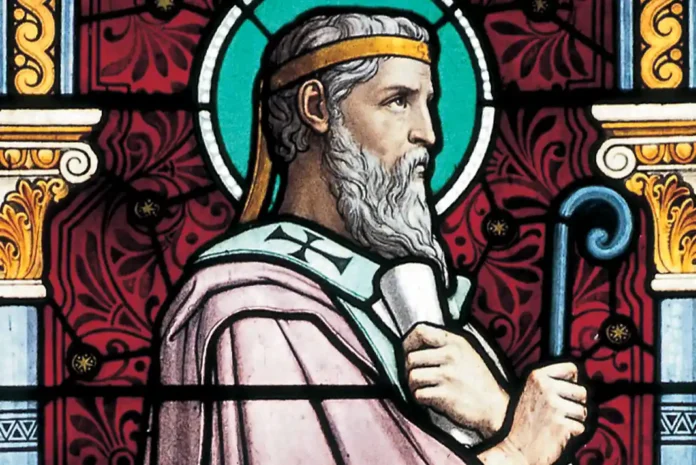
On the early Church fathers, their genuine value, their real limitations, and why the words of Jesus should settle the question.
A friend was excited. He had been listening to several pastors lately, and all of them, he said, were talking about the rapture. You could hear in his voice the particular zeal of someone who has found a convergence: multiple voices saying the same thing, all pointing at the same horizon. The end is near. The antichrist is coming. Things are aligning. Jesus is coming soon.
I asked him a question: “Do you want to know when Jesus says the rapture is going to be?”
He went quiet.
“I’ll show you. This is from John 6.”
We opened the gospel. Four times in a single chapter, Jesus answers the question directly. Not in metaphor, not in apocalyptic imagery requiring special decoding, but in plain declarative sentences addressed to the people standing in front of him:
“Everyone whom the Father gives me I will come to, and whoever comes to me I will never cast out. For I have come down from heaven not to do my own will but the will of him who sent me. And this is the will of him who sent me, that I should lose nothing of all that he has given me, but raise it up on the last day.” (John 6:37–39)
“For this is the will of my Father, that everyone who looks to the Son and believes in him should have eternal life, and I will raise him up on the last day.” (John 6:40)
“No one can come to me unless the Father who sent me draws him. And I will raise him up on the last day.” (John 6:44)
“Whoever feeds on my flesh and drinks my blood has eternal life, and I will raise him up on the last day.” (John 6:54)
Four times. The last day. Not before the tribulation. Not before the antichrist rises. Not before a thousand-year millennial reign. On the last day. Then, just to drive the point home, we turned to John 11, where Martha—not a theologian, not an apostle, but a grieving woman who just buried her brother—expresses what early, first-century believers understood without being taught it from a systematic theology textbook: “I know that he will rise again in the resurrection on the last day” (John 11:24). And Jesus does not correct her. He confirms her.
When we finished, a second friend in the room was quiet for a moment. Then he said: “Well, okay. Not discounting any of what you read. But what about what Irenaeus says?”
It’s a fair question, and it deserves a real answer. Let’s give it one.
Who Was Irenaeus?
Irenaeus of Lyon was a second-century bishop who lived approximately 130–202 AD. He is one of the most significant figures in early Christian history, primarily because of his massive work Against Heresies, written around 180 AD. His purpose in writing it was to refute the Gnostic heresies that were spreading through the early Church, particularly the teachings of Valentinus and Marcion. In this he did substantial and valuable work. We owe him a genuine debt.
His credentials were not negligible. He was a disciple of Polycarp, who was a disciple of the Apostle John. This places him, generationally, remarkably close to eyewitness testimony. When people invoke Irenaeus as an authority, this apostolic proximity is what they are reaching for: here is someone who sat under someone who sat under an apostle. Surely that means something.
We should say that clearly before we say anything else. Irenaeus was not a crank. He was not a fringe figure. He was a serious theologian defending serious truth against serious error, and the Church is genuinely in his debt.
But proximity to an eyewitness is not the same as being an eyewitness. And sitting under Polycarp who sat under John is not the same as sitting under John. The chain of transmission, however short, introduces the possibility of error at every link. Irenaeus himself demonstrates this, as we will see.
What Pretribulation Theories Claim Irenaeus Teaches
The pretribulation rapture position—the view that the Church will be removed from the earth before a seven-year tribulation period—is a relatively recent doctrine. Its birth is attributed to John Nelson Darby and the Plymouth Brethren in the early 1830s. Before Darby established the doctrine of a pretribulational rapture, the Church historically tied the moment of our transformation to the resurrection on the last day, not to an escape from wrath or persecution. It was then popularized through the Scofield Reference Bible, the writings of Hal Lindsey, and most recently the Left Behind franchise. Its defenders are aware of this timeline and have worked hard to find earlier precursors, because a doctrine without historical roots is a vulnerable doctrine. The appeal to Irenaeus is the most serious of those attempts. It deserves a serious response.
The early creeds are worth noting here. The Apostles’ Creed, which dates to the second century, and the Nicene Creed of the fourth century both affirm the resurrection of the dead and the judgment of the living and the dead. Neither mentions a rapture. Neither mentions a pretribulation removal of the Church. If the second-century Church had a robust pretribulation rapture theology, we would expect to find traces of it in its most foundational confessions. It is not there.
Irenaeus is their most frequently cited early source. The key passage comes from Against Heresies 5.29.1, where he writes:
“And therefore, in the end when the Church is suddenly caught up from this, it is said, ‘There shall be tribulation such as has not been since the beginning, neither shall be.’ For this is the last contest of the righteous, in which, when they overcome, they are crowned with incorruption.”
Pretribulation proponents read this as a second-century witness to the pretrib rapture: the Church is caught up, then the great tribulation begins. If Irenaeus taught it, they argue, it cannot be a nineteenth-century invention.
The problem with this reading
The problem is that Irenaeus does not agree with himself on this point—not within the same book, not within a few chapters of the passage quoted above. In Against Heresies 5.26.1, just three chapters earlier, he writes about the ten kings of Daniel and Revelation, and then says plainly: “And they shall lay Babylon waste, and burn her with fire, and shall give their kingdom to the beast, and put the Church to flight.”
Read that carefully. The Church is not removed before the tribulation. The Church is put to flight during it. Irenaeus explicitly places the Church inside the tribulation period in one passage and appears to remove it before the tribulation in another. Scholars across the spectrum have noted this apparent contradiction, and it has divided pretribulation and post-tribulation camps alike who wish to claim Irenaeus for their position.
The honest conclusion, reached by careful scholars on both sides, is that Irenaeus did not have a systematized rapture theology. He was writing polemically against Gnosticism, not constructing a dispensational timeline. Reading his eschatological remarks as a coherent pretrib system requires importing a framework that Irenaeus did not possess and almost certainly did not intend.
Additionally, Irenaeus was a premillennialist—he believed in a literal future earthly kingdom of Christ lasting one thousand years, rooted in God’s promises to Abraham about the land. This is worth noting because modern pretribulation dispensationalism is a very specific subset of premillennialism that includes a host of additional commitments (the Israel-Church distinction, the two-phase return of Christ, the gap between the rapture and the second coming) that are simply not present in Irenaeus. Citing him as a pretrib witness requires him to have believed far more than he actually wrote.
What Irenaeus Did Teach About the End Times?
Setting aside the rapture question, Irenaeus’s eschatology in Against Heresies Book V is worth understanding on its own terms—including the ways it directly contradicts the pretribulational position that claims him as a forebear.
The Prophecy Course’s session on the millennial reign summarizes his actual sequence clearly. In book five, chapter 35 of Against Heresies, Irenaeus lays out his end-times order:
- tribulation first, then
- Christ’s return, then
- a single general resurrection of the just, then
- a millennial reign from an earthly New Jerusalem, then
- final judgment, then
- the descent of the heavenly New Jerusalem.
This is historic premillennialism of a distinctly post-tribulational variety. The Church goes through the tribulation. There is no prior removal. The man pretribulationists cite as their second-century witness held a sequence that is the structural opposite of what they teach.
It is also worth noting what Irenaeus rebuked in that same passage. He explicitly criticized the spiritual or allegorical reading of the kingdom of God—what we would today call the amillennial position—considering it hermeneutically inconsistent. Those of us who hold the amillennial position here at Levaire can say plainly: Irenaeus disagreed with us on this point. We are not selectively citing him where he supports us and ignoring where he does not. He disagreed with the pretribulational view on the sequence and he disagreed with us on the millennium. This is what honest engagement with the fathers looks like.
The fact that amillennialism required rebuttal in 180 AD is itself historically significant. The pretribulation argument often declares the early Church was premillennial, therefore premillennialism has ancient roots, therefore pretribulationism (as a premillennial subset) has historical legitimacy. But if amillennialism was already the main competing view in Irenaeus’s own moment, premillennialism was not the unchallenged position of the ancient Church. It was one side of an active debate already underway in the second century.
His arguments for the millennium were rooted in God’s covenant promises to Abraham. He wrote:
“The promise remains steadfast… God promised him the inheritance of the land. Yet Abraham did not receive it during all the time of his journey there. Accordingly, it must be that Abraham, together with his seed (that is, those who fear God and believe in Him), will receive it at the resurrection of the just.”
This is the premillennial argument from covenant faithfulness, and it is a serious theological argument that deserves engagement on its merits.
His errors in this section are equally instructive. He futurized Isaiah 13:9—a day of the Lord judgment spoken over Babylon—treating it as a yet-unfulfilled prophecy. In fact, that judgment was fulfilled by Medo-Persia in 539 BC, centuries before Irenaeus wrote. This is the same category of interpretive error that drives modern pretribulationism’s reading of the Olivet Discourse: taking texts that were fulfilled in the first century and projecting them forward into an indefinite future. Irenaeus made this move with Isaiah 13. He should not have.
He also built part of his millennial argument on an extended quotation from the apocryphal book of Baruch—a text the Protestant canon does not include and which the broader early Church held with varying degrees of authority. This does not invalidate everything he argued, but it is a reminder that his theological sources were broader and less curated than his admirers sometimes acknowledge. He was working with the texts available to him, and not all those texts carry equal weight.
What it is not is a clearly systematized pretribulation rapture theology. The two are not the same thing, and conflating them does a disservice both to Irenaeus and to the question.
The Documented Errors of Irenaeus
Here is where we must be honest about a man we genuinely respect. Irenaeus made significant errors, and acknowledging them is not disrespectful. It is simply accurate, and accuracy is what we owe our readers.
Jesus was almost fifty years old
The most documented error in Irenaeus is his argument in Against Heresies 2.22.5 that Jesus was not thirty-three years old when he died but closer to fifty. His reasoning was drawn from John 8:57, where the Jewish leaders say to Jesus: “You are not yet fifty years old, and have you seen Abraham?” Irenaeus argued that this language would only have been applied to someone who had nearly reached fifty: “Such language is fittingly applied to one who has already passed the age of forty, without having as yet reached his fiftieth year.” He concluded that Jesus was somewhere between forty and fifty years old at his crucifixion, and that his ministry lasted not three years but nearly twenty.
He then claimed this was not merely his own inference but came from tradition: “All the elders who associated with John the disciple of the Lord in Asia bear their testimony that John conveyed this information to them.” He attributed the teaching to John himself, transmitted through Polycarp.
This is wrong. It contradicts Luke 3:23, which says Jesus “was about thirty years of age” when he began his ministry. It contradicts the timeline of all four gospels. It requires a ministry of nearly twenty years for which there is no historical evidence anywhere. And it illustrates something important: even a man with a direct chain to an apostle can misremember, misinterpret, or simply err. The claim to apostolic tradition does not guarantee accuracy. If the tradition Irenaeus received was actually from John, then John’s transmission was garbled in the receiving. If it was not from John, then Irenaeus was wrong about his source.
Either way, the lesson is the same: proximity to the apostles is not a substitute for scriptural precision.
The 500 AD prediction
As the Prophecy Course documents in its survey of end-times error, Irenaeus was among the early Church fathers who predicted Jesus would return in 500 AD. The calculation was partly based on the dimensions of Noah’s Ark from Genesis 6:15-16—creative, certainly, but not the kind of exegesis that has aged well. He was joined in this prediction by Hippolytus of Rome and Sextus Julius Africanus. All three were wrong. The end-times error documented in that lesson—a hall of shame stretching from the Jewish Essenes through Harold Camping — includes the early Church fathers near the top of the list. Being early does not exempt anyone from prophetic miscalculation.
The polemical context of his eschatology
A third limitation is less an error than a distortion of emphasis. Irenaeus was writing Against Heresies, not writing a systematic theology of the last things. His eschatological statements were made in service of his anti-Gnostic argument: he was defending the goodness of physical creation, the reality of bodily resurrection, and the faithfulness of God to his covenant promises against Gnostic teachers who denied all of these things. His premillennialism served this argument. The physical, earthly, bodily kingdom was his answer to Gnostic spiritualism.
This means we should be cautious about treating his eschatological remarks as disinterested, carefully constructed theology. He was a polemicist with a target. His theological positions were shaped by what he was arguing against, not only by what the text requires. This is true of all of us to some degree, and it does not make his work worthless. It does mean we should read him with that context in mind.
A Confession About Using the Church Fathers
We should say plainly: the authors at Levaire have used the early Church fathers to make arguments. We have cited Irenaeus, Polycarp, Justin Martyr, and others to establish historical context, to demonstrate what the early Church believed, and to bolster positions we hold on other grounds. We will likely do so again. There is a legitimate use of the fathers as witnesses to the early Church’s understanding, and we do not want to abandon that.
But we have also sometimes leaned on them more heavily than we should have, as though their testimony settles a question that Scripture has already addressed. And we want to acknowledge that publicly, because intellectual honesty requires it.
The early Church fathers are not Scripture. They are not inspired. They are not inerrant. They are, at their best, serious, faithful, often brilliant men who read the same texts we read and reached conclusions that deserve engagement. At their worst, they were shaped by their cultural moment, their polemical targets, their limited access to the full canon of historical information we now possess, and the ordinary fallibility of human reasoning. Sometimes they got things spectacularly wrong.
Even the apostles, walking with Jesus, got things wrong. Peter required a vision and a confrontation from Paul before he would fully extend the gospel to the Gentiles (Galatians 2:11–14). The disciples repeatedly misunderstood Jesus’ predictions about His death and resurrection, even after He had explained them multiple times (Mark 9:31–32). The mother of James and John asked Jesus to seat her sons at His right and left hand in His kingdom (Matthew 20:20–21)—a request that reveals a complete misunderstanding of what kind of kingdom Jesus was establishing. If the people who were physically present with Jesus misread Him in spectacular ways, we should not be surprised that men—two generations later, working from oral tradition and incomplete writings—also got things wrong.
The question is not whether Irenaeus was a great man. He was. The question is whether his testimony can override what Jesus said. And on that question, there is only one answer.
Resurrection and Rapture in John 6
Jesus is asked, across the course of His ministry, the question His followers most want answered: when? When will the resurrection come? When will the righteous be raised? His answer is consistent and plain. Four times in John 6 alone He gives it: on the last day.
Not on the day the antichrist rises. Not before the tribulation. Not in a secret pre-return event separate from His visible second coming. On the last day.
Martha understood this. Standing before our Lord, grieving, she said: “I know that he will rise again in the resurrection on the last day” (John 11:24). Jesus did not say, “Well, actually, it’s a bit more complicated than that.” He said: “I am the resurrection and the life. Whoever believes in me, though he die, yet shall he live.” He confirmed her. The last day is the day.
The biblical pattern across both testaments is preservation through trial, not extraction before it. Noah was not raptured out of the flood; he was carried through it. Lot was not removed before Sodom burned; he was led out of it. Israel was not raptured out of the plagues of Egypt; they were preserved through them and led out after. Shadrach, Meshach, and Abednego were not raptured out of the fire; a fourth figure walked with them inside it. Daniel spent the night in the lions’ den. The first-century Church was not raptured out of the tribulation of their days. In every case, the pattern is the same: God’s people endure, are preserved from His wrath, and are brought through. The pretribulation position requires a different God than the one the whole of Scripture describes.
The Prophecy Course’s session on resurrection and rapture works through this material in detail, including the key 1 Thessalonians 4 passage that is the primary proof text for the pretribulation position and the question of what Paul actually meant by “caught up” (harpazo) and when he said it would happen. The session on the millennial reign addresses the premillennial framework that Irenaeus held and the amillennial reading that we find more consistent with the whole of Scripture. We commend both for further study.
The point here is simpler. When a brother in Christ says “but what about Irenaeus?” the answer is not to dismiss Irenaeus. He is worth reading. Against Heresies is worth engaging. His genuine contributions to Christian theology deserve our respect.
But Irenaeus is not Jesus. And when Irenaeus and Jesus appear to disagree, the question answers itself.
How to Use the Church Fathers Well
We want to end somewhere constructive. The early Church fathers are not worthless because they were fallible. They are valuable witnesses to the early Church’s reading of Scripture, to the questions that were live and contested in the first centuries of Christianity, and to the ways the gospel was defended against the specific heresies of their moment. Reading them enriches our understanding. Dismissing them entirely would be its own kind of error.
But they should be read as witnesses, not as authorities. A witness tells you what they saw and understood. An authority settles the question. Scripture is our authority. The fathers are witnesses to how Scripture was read, and their testimony is more valuable when it is early, widely attested, and consistent with the text—and less valuable when it is late, idiosyncratic, or in tension with the text.
When a Church father supports what the text clearly says, cite him gladly. When a Church father contradicts what the text clearly says, the text wins. This is not a Protestant invention. It is the principle the Bereans practiced in Acts 17:11, examining the Scriptures daily to see whether what they were being told was so—and the Bereans were being taught by Paul.
Be a Berean. Read Irenaeus. Read the text. And when you find yourself in a conversation with an excited brother who has been listening to a lot of pastors talking about the rapture, ask him the question:
“Do you want to know when Jesus says the rapture is going to be?”
Then open John 6. Let Jesus answer.
“For this is the will of my Father, that everyone who looks to the Son and believes in him should have eternal life, and I will raise him up on the last day.” (John 6:40)

Further Reading and Study
Prophecy Course, Session 3: You’re Probably Wrong: A survey of end-times error from the Jewish Essenes to Harold Camping, including the early Church fathers. https://prophecycourse.org/session/03/wrong/
Prophecy Course, Session 6: Resurrection and Rapture: A careful exegesis of the key rapture texts including 1 Thessalonians 4, John 6, and John 11. https://prophecycourse.org/session/06/rapture/
Prophecy Course, Session 11: Millennial Reign of Christ: An amillennial reading of the thousand-year reign, engaging the premillennial tradition Irenaeus represents. https://prophecycourse.org/session/11/reign/
Irenaeus of Lyon, Against Heresies (c. 180 AD). Available in full at newadvent.org. Book II, Chapter 22 for the Jesus age error; Book V, Chapters 25–29 for the eschatological material.
H. Kromminga, The Millennium in the Church (Eerdmans, 1945). A thorough historical survey of millennial views in the early Church, useful for understanding what Irenaeus actually believed in context.



Good research. However, the Bibke says their are two resurrection. Paul says it twice in Acts and Revelation 20 says there is a resurrection at the Millennial reign and then a resurrection at the white throne judgment. To say the resurrection is on “the last day” would emply there are two resurrections on the same day. Which doesn’t align with the narrative of God’s word.
So scripture speaks of “the coming Day of the Lord” over and over. The Day Jesus returns with His angels in flaming fire (2 Thess 1-2). I would argue the “last day” is the final day of this age before the coming Day of the Lord.
And technically there is still a resurrection on the last day. The 2nd resurrection at the white throne judgment.